Coastal marine layers and warm canyon microclimates make Southern California an active habitat for wood-destroying insects. In communities from Ocean Beach and Point Loma to Mission Hills and Scripps Ranch, structural…
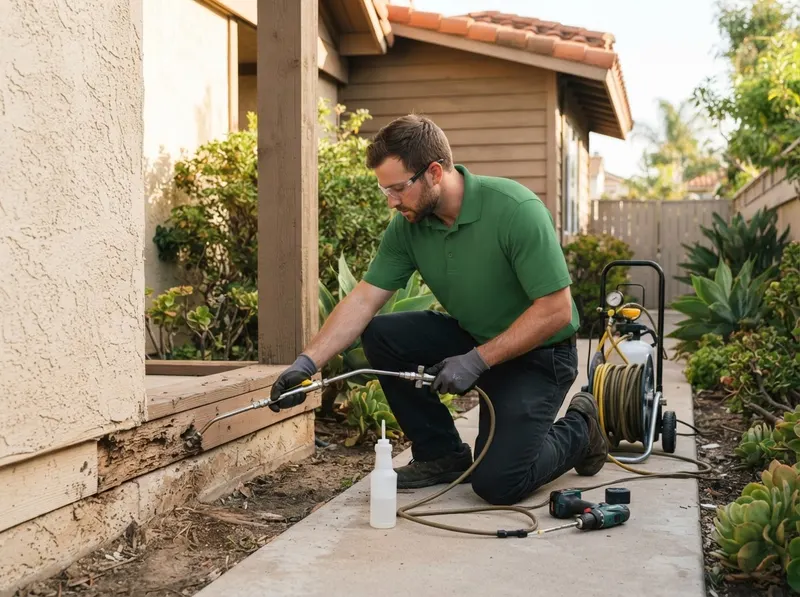
Coastal marine layers and warm canyon microclimates make Southern California an active habitat for wood-destroying insects. In communities from Ocean Beach and Point Loma to Mission Hills and Scripps Ranch, structural integrity requires distinct protocols for aerial drywood colonies versus subterranean ground colonies. Western drywood termites (Incisitermes minor) establish nests inside structural lumber, attic rafters, fascia boards, and window casings without needing soil moisture contact. Conversely, Western subterranean termites (Reticulitermes hesperus) live underground and construct moisture-retaining mud tubes across stem walls and foundation footings. Eradication requires precise differentiation under guidelines established by the California Structural Pest Control Board.
EcoGuard Extermination uses an Integrated Pest Management protocol that targets the specific biological habits of each species. For drywood infestations, technicians avoid non-selective whole-house toxic fumigation when colonies remain localized to specific framing zones. Injecting low-toxicity, natural mineral borate compounds directly into verified wood kick-out galleries preserves indoor air quality while meeting safety recommendations from the California Department of Pesticide Regulation. Mineral borates act as systemic metabolic inhibitors inside the wood fibers, rendering the framing unpalatable to wood-boring insects over decades. For subterranean networks entering along concrete seams in Clairemont or Carmel Valley slab homes, technicians apply undetectable non-repellent liquid barriers along exterior perimeter trenches. Foraging workers unknowingly transport active ingredients back to the reproductive queen, neutralizing the subterranean nest per research from the University of California Statewide Integrated Pest Management Program.
Environmental stewardship balances structural defense with environmental preservation near sensitive coastal ecosystems like Mission Bay Park, Torrey Pines State Natural Reserve, and Cabrillo National Monument. Exterior soil treatments comply with groundwater protection protocols governed by the San Diego Regional Water Quality Control Board and pesticide runoff containment standards from the United States Environmental Protection Agency. In older craftsman homes across North Park and historic properties near Balboa Park, localized micro-injection preserves intact lath, plaster, and custom timber framing while eliminating termites. This focused approach circumvents the roof walking, tile breakage, and gas venting risks tied to conventional chemical tenting. Technical specifications and active chemistries reference standard guidelines from the Pest Control Technology Technical Resource Center and safety practices from the Occupational Safety and Health Administration.
1. Initial structural diagnostics map kick-out frass, hollowed timber channels, and subterranean mud conduits across exterior foundation walls, sub-areas, and attics.
2. Species identification isolates drywood or subterranean presence to determine whether wood micro-injections or continuous perimeter soil saturation is required.
3. Spot or barrier treatment deploys directed borates, targeted foam applications, or non-repellent transfer agents into active galleries, structural joints, or foundation soil.
4. Documentation and structural verification confirm wood integrity, establishing baseline monitoring points across crawlspaces and attic framing without binding properties to automatic monthly service charges.
Every job gets a firm, written price after a free on-site visit.
For standards, safe disposal, and service guidance on pest control services in San Diego, CA, useful references include U.S. EPA, ENERGY STAR, U.S. Dept. of Energy, Consumer.gov, U.S. Census Bureau, and Google Maps. General consumer and small-business resources are available from USA.gov, Better Business Bureau, FTC Consumer Advice, U.S. Small Business Administration, and Ready.gov.
Tell us about your drywood and subterranean termite treatment job in San Diego and we'll send a clear, written quote, usually the same day.
 EcoGuard Extermination